
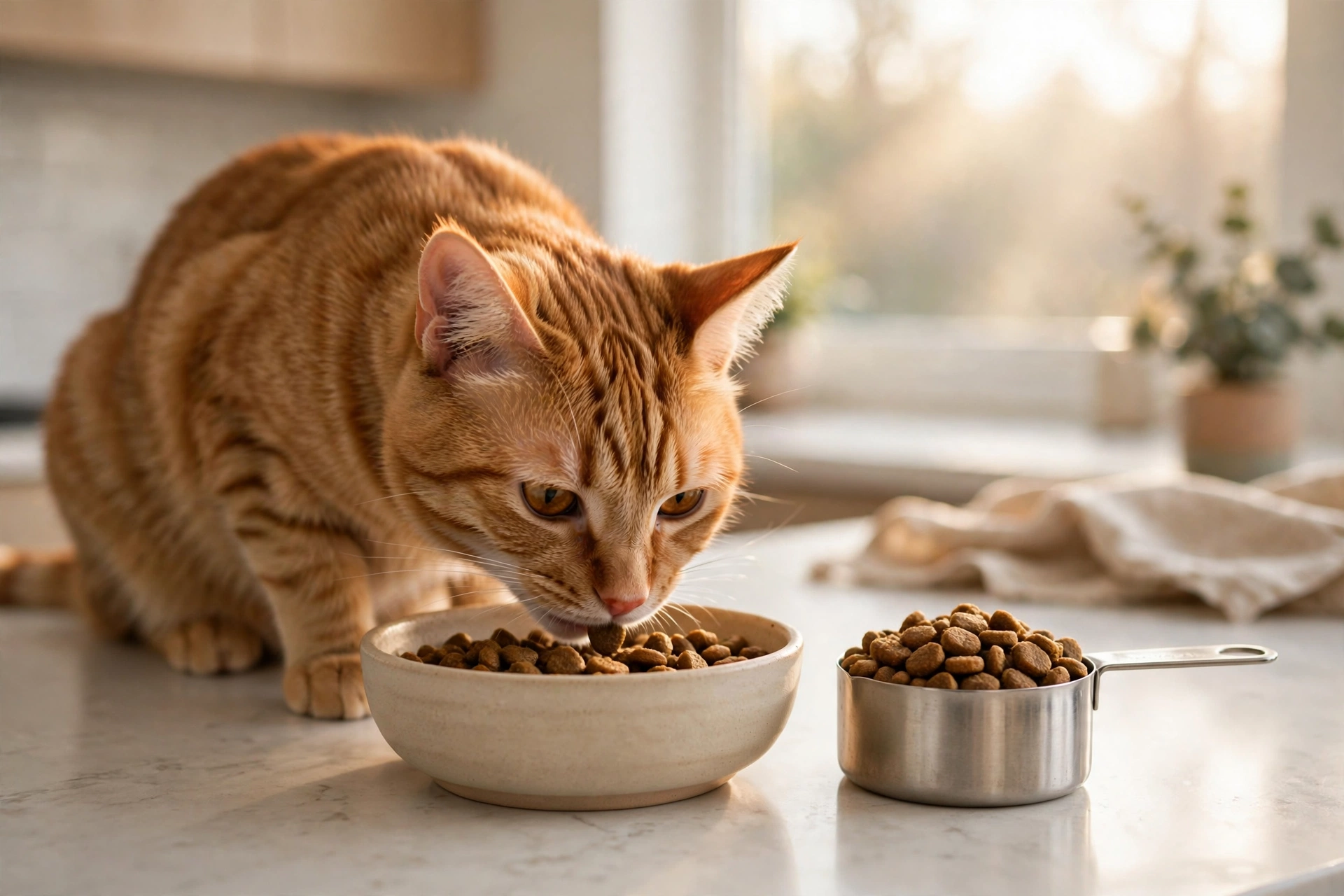
How Much Should I Feed My Cat? Chart by Age & Weight
Short answer: most adult indoor cats need about 20–25 calories per pound of body weight per day — roughly 200–250 kcal for a 10-pound cat, split into two meals. Kittens need far more per pound to fuel growth, seniors need a little less, and spayed or neutered indoor cats need about 20% fewer calories than active intact cats. Use the charts below as your starting point, then adjust until your cat holds a healthy body condition — and confirm the plan with your vet.
Overfeeding is the most common feeding mistake cat owners make. Veterinary surveys estimate that around 60% of cats in the US are overweight or obese, and most of those owners thought they were feeding “a normal amount.” The fix isn’t complicated — it’s just math plus observation. Here’s the math.
Adult Cat Feeding Chart by Weight
These daily calorie ranges follow veterinary nutrition guidelines (WSAVA Global Nutrition Committee) for average adult cats. Your cat’s ideal number depends on activity level, age, and whether they’re spayed or neutered — the leaner, lazier, and more “indoor” the cat, the closer to the low end.
| Cat’s weight | Daily calories | Dry food/day* | Wet food/day** |
|---|---|---|---|
| 6 lb (2.7 kg) | 190–210 kcal | ⅓–½ cup | 5–6 oz (about 2 small cans) |
| 8 lb (3.6 kg) | 220–250 kcal | ½–⅔ cup | 6–7 oz (about 2–2½ cans) |
| 10 lb (4.5 kg) | 240–280 kcal | ⅔–¾ cup | 7–8 oz (about 2½–3 cans) |
| 12 lb (5.4 kg) | 260–320 kcal | ¾–1 cup | 8–9 oz (about 3 cans) |
| 14 lb (6.4 kg) | 275–350 kcal | ¾–1 cup | 9–10 oz (about 3–3½ cans) |
Based on a typical dry food at ~350 kcal/cup. **Based on typical wet food at ~75 kcal per 3-oz can. Calorie density varies a lot between brands — always check the kcal/kg or kcal/can printed on your food’s label and adjust.
Two things to notice: first, the ranges are wide on purpose, because a sleepy 12-pound couch cat and an athletic 12-pound hunter genuinely need different amounts. Second, if your cat is overweight, calculate using their ideal weight, not their current weight — feeding an overweight 14-pound cat for 14 pounds just maintains the problem.
How to Calculate Your Cat’s Daily Calories
The chart gets you close, but here’s how to personalize it:
The 20-calorie rule (simplest). Multiply your cat’s ideal weight in pounds by 20. A 10-pound cat → 200 kcal/day. Then adjust:
- Spayed/neutered and mostly inactive: subtract ~20% (× 0.8) → ~160–200 kcal
- Average indoor adult: use the number as-is → ~200 kcal
- Very active or outdoor cat: add 20–40% (× 1.2–1.4) → ~240–280 kcal
The veterinary formula (more precise). Vets calculate Resting Energy Requirement as RER = 70 × (body weight in kg)^0.75, then multiply by a life-stage factor: about 1.2 for a neutered adult, 1.4 for an intact adult. For a 4.5 kg (10 lb) neutered cat, that works out to roughly 200–220 kcal/day — right in line with the simple rule. You don’t need to do this math yourself; the 20-calorie rule gets you to the same neighborhood.
Whichever method you use, treat the result as a starting guess, not a prescription. Feed that amount for 2–3 weeks, weigh your cat, and adjust up or down by 10% until their weight is stable and their body condition looks right.
Kitten Feeding Chart by Age
Kittens are calorie furnaces. A growing kitten can need two to three times the calories per pound of an adult cat, and those needs shift fast as they grow. Feed a food labeled “complete and balanced for growth” or “all life stages” under AAFCO standards — adult cat food doesn’t have enough protein or calories for kittens. (Individual kittens vary enormously — up to 50% in either direction — so treat these as starting points and adjust with your vet.)
| Age | Meals per day | Daily calories | Notes |
|---|---|---|---|
| 6–8 weeks (weaning) | 4 | 130–200 kcal | Wet kitten food, mashed or gruel-like |
| 2–3 months | 3–4 | 200–300 kcal | Wet, dry, or mixed kitten food |
| 4–6 months | 3 | 270–360 kcal | Peak growth — biggest appetites are normal |
| 6–12 months | 2–3 | 250–400 kcal | Growth slows; taper portions toward adult levels |
Practical notes for kitten feeding:
- Keep them on kitten food until about 12 months (18–24 months for large breeds like Maine Coons). Switching to adult food too early shortchanges growth.
- No cow’s milk. Most kittens lose lactose tolerance after weaning, and milk causes diarrhea. Kitten milk replacer (KMR) is only for unweaned orphans.
- Spay/neuter changes the math. Appetite often stays high after the surgery while calorie needs drop — this is when many cats start gaining. Reduce portions by about 20% after spaying/neutering unless your vet says otherwise.
- Small, frequent meals suit tiny stomachs. As they approach a year old, gradually consolidate to the adult two-meal rhythm.
Senior Cats (11+): What Changes
Senior cats typically need slightly fewer calories as metabolism and activity slow down — many do well around 180–240 kcal/day — but served as 2–3 smaller meals, since older digestive systems handle small portions better. Prioritize highly digestible animal protein to protect aging muscle mass.
The bigger senior feeding rule: watch for weight loss, not just weight gain. An older cat dropping weight while eating normally can signal hyperthyroidism, kidney disease, or diabetes — all common and all manageable when caught early. Weigh seniors monthly, and report a loss of more than a few ounces to your vet promptly.
Wet, Dry, or Both? Converting Calories to Real Portions
The format matters less than the calorie total, but each has trade-offs:
- Wet food (~70–90 kcal per 3-oz can): excellent for hydration. Cats evolved as desert animals with a weak thirst drive, and many barely drink enough water — wet food quietly fixes that. It’s also usually higher in protein.
- Dry food (~300–450 kcal/cup): convenient and calorie-dense, which is exactly why it’s easy to overfeed. Great for puzzle feeders and grazers who self-regulate — but most cats don’t self-regulate.
- Mixed feeding is the sweet spot for most households: wet food for hydration and protein, a measured amount of dry for convenience and dental crunch.
A worked example: your 10-pound indoor cat needs ~220 kcal/day. That’s roughly 3 small cans of wet food, OR about ⅔ cup of a 350-kcal/cup dry food, OR 1½ cans of wet plus ⅓ cup of dry. Same calories, three valid ways to get there.
One non-negotiable: measure with a real measuring cup or a kitchen scale, not a coffee mug or a scoop. Studies have repeatedly found that “eyeballed” portions run 20–50% over the intended amount — which is exactly how a 10-pound cat quietly becomes a 14-pound cat.
How Many Meals Per Day?
- Adult cats: 2 meals, roughly 12 hours apart. This is the standard recommendation and it works — it gives you portion control and a daily appetite check (a cat that skips a meal is telling you something).
- Kittens: 3–4 small meals, tapering to 2 as they approach adulthood.
- Seniors: 2–3 smaller meals.
- Grazers: if your cat genuinely nibbles a measured daily portion without inhaling it, timed free-feeding of dry food can work — but measure the day’s total in the morning and don’t refill. The moment weight creeps up, switch to scheduled meals.
Keep meal times consistent. Cats are creatures of routine, and a predictable schedule also makes appetite changes — often the first sign of illness — easy to spot.
Treats and Extras: The 10% Rule
Treats should make up no more than 10% of daily calories — for a 200-kcal cat, that’s just 20 kcal, or a small handful of typical treats. Dental treats, freeze-dried toppers, and table scraps all count. A slice of deli turkey here and there won’t hurt, but “just a bite” of calorie-dense human food adds up fast in a 10-pound animal. If treats are a big part of your bonding routine, subtract their calories from meals.
Signs You’re Feeding Too Much (or Too Little)
Forget the scale for a second and use your hands and eyes — the 9-point body condition score is what vets actually use:
Probably overfeeding if: you can’t easily feel the ribs under a thin fat layer, there’s no visible waist when viewed from above, the belly pouch swings when they walk, or they’re gaining weight month over month.
Probably underfeeding if: ribs, spine, or hip bones are prominent with little covering, the coat looks dull, or there’s steady weight loss.
Just right (score 4–5 out of 9): ribs are easily felt but not seen, there’s a visible waist behind the ribs, and weight is stable. Weigh your cat monthly — a bathroom scale works if you weigh yourself holding the cat and subtract — and adjust food by 10% whenever the trend moves the wrong way for more than a month.
When to Ask Your Vet About Feeding
Charts cover healthy cats. Talk to your vet for a personalized feeding plan if:
- Your cat needs to lose or gain a significant amount of weight (crash diets are dangerous for cats — rapid weight loss can trigger fatty liver disease)
- There’s been a sudden appetite or weight change
- Your cat has diabetes, kidney disease, hyperthyroidism, urinary issues, or food allergies — these need prescription or therapeutic diets, not just smaller portions of regular food
- You’re feeding a pregnant or nursing queen (they can need 2–4× normal calories)
- You want to try homemade or raw feeding (these need formulation by a board-certified veterinary nutritionist to avoid dangerous deficiencies — cats can’t synthesize taurine or vitamin A, so guesswork is risky)
For a sense of what a vet visit costs, see our guide on what a vet visit costs.
Frequently Asked Questions
Can I feed my cat once a day?
It’s not ideal. Cats’ small stomachs and fast metabolisms suit two or more smaller meals. One large daily meal can cause vomiting from eating too fast and leaves a long stretch with an empty stomach. Stick with two meals minimum for adults.
Is free-feeding dry food okay?
Only if you measure the full day’s portion each morning and your cat genuinely grazes without gaining weight. In practice, constant access to calorie-dense kibble is the most common cause of feline obesity. If the scale creeps up, switch to timed meals.
Should I just follow the feeding guide on the bag?
Use it as a rough starting point, not gospel. Bag guides are written for the “average” cat and often run generous — pet food companies don’t lose money when you feed more. Calculate from your cat’s ideal weight using the 20-calorie rule, then adjust based on actual body condition.
How do I switch my cat to a new food?
Gradually, over 7–10 days: mix increasing amounts of the new food into the old (25/75, then 50/50, then 75/25). Cats are neophobic about food and abrupt switches commonly cause vomiting, diarrhea, or a hunger strike. Go slower for sensitive stomachs.
My cat begs constantly — is he starving?
Probably not. Begging is often habit, boredom, or learned behavior (it worked once, so it keeps working). Check the real indicators: stable weight and good body condition mean he’s fed enough. Redirect begging with play sessions instead of snacks — most “hungry” cats are actually under-stimulated.
Do indoor cats need fewer calories than outdoor cats?
Yes — typically 20–30% fewer. Indoor cats burn far less energy patrolling, hunting, and thermoregulating. An indoor-only cat fed “outdoor” portions will gain weight steadily. This is the single biggest reason indoor cats become obese.
This article is for informational purposes only and is not a substitute for professional veterinary advice. Calorie needs vary between individual cats — always confirm your cat’s feeding plan with your veterinarian, especially for kittens, seniors, or cats with health conditions.


